Thứ Tư, 19 tháng 8, 2015


Special Cover – Madhubani Paintings

image

On 17th August 2015, Special Cover featuring “Madhubani Paintings” was released at Sitamarhi, Bihar. The release of this Special Cover was approved by Chief Postmaster General, Bihar Circle.

The Cover depicts the image of ‘Sita Swayamvar” in Madhubani style of paintings. The top and bottom border of the cover also shows  Madhubani Painting . The Special Postmark features  images of Ram & Sita.


image

- Pradeep Kumar Mallik – PATNA : email : mallikphila@gmail.com

Set of 48 Picture Postcards released by North Karnataka Postal Region - 15th August 2015

image

Postcrossing Team, North Karnataka Postal Region has released a set of 48 picture postcards titled ‘Incredible India’ on 15th August 2015. The set is available in an attractive box and is priced Rs. 150 per set. This is 10th set of picture postcards issued by North Karnataka Postal Region. After its launch 10 sets of picture postcards were given away free of cost to first 10 persons who sent request on Facebook page of Postcrossing India.

image

On the address side of picture postcards text ‘IN’ and 6 boxes has been provided for the use of Postcrossing (a postcard exchange project) members to mention the POSTCARD ID.

Contact for more information: nkrpostcrossing@gmail.com

Courtesy – Indian Philately Digest

Thứ Hai, 9 tháng 3, 2015


image

Date of Issue : 24 February 2015

Polish Post issued a beautiful souvenir sheet on Witcacy featuring him and his famous painting in a very  extraordinary design.Stanisław Ignacy Witkiewicz (24 February 1885 – 18 September 1939)  , commonly known as "Witkacy", was a Polish poet, playwright, novelist, painter, photographer and philosopher.Witkacy was one of the leading members of Poland's poetic and artistic avant-garde of the first half of the 20th century.

image

Self Portrait of Witkacy

image

 Read More ..

Stamp Exhibition in Berlin 

Greetings from Oman

image

Exhibition opening with a large train station

(BDPh) Philately from the Middle East is rarely seen, and certainly not in this compressed form. A range of modern issues and postal history exhibits with high honors in FIP exhibitions currently on view at the Museum of Communication in Berlin. Interesting remarks about the country and people, post utensils and other country-specific exhibits provide an insight into the exotic country.Franz-Josef Pütz Philatelists Association of Berlin Brandenburg  organized the exhibition jointly with the German-Omani society in months of preparation .

image

Photo: Chairman of the Omani Sultan Philatelic Society Hilal Al Habsi and BDPh President Uwe Decker

The opening ceremony was held on 5 March 2015 and museum director Dr. Lieselotte Kugler opened the exhibition in front of about 400 guests.  Minister of Tourism, Sultanate of Oman SH Ahmed bin Nasser Al Mahrizi, Oman's Ambassador Ba Omar and senior representatives from politics and society  were present. The Philatelists Association Berlin Brandenburg was represented by Frank Walter and his designated successor, Dr. Klaus-Dieter Schuldt and other board members. The representative of the Omani Sultan Philatelic Society Hilal Al Habsi had with BDPh President Uwe Decker a call via the Association of Philatelic on site.

image image


The exhibition will be open during the opening times of the Communication Museum on view until March 29, 2015 and provides an opportunity to get to know now the modern state in accordance with ancient traditions in the mirror of philately.

Museum of Communication, Leipziger Str. 16, 10117 Berlin-Mitte

www.mfk-berlin.de

- Wolfgang Beyer- Germany email :

Thứ Tư, 5 tháng 11, 2014


image 

Date of Issue : 29 October 2014

Brazilian Post issued a special stamp on 29th October, dedicated to graphic art known as kusiwa. The stamp release depicts the example of such an unusual art.

The Wajapi of the Tupi-guarani cultural-linguistic group are indigenous to the northern Amazonian region. Some 580 Wajapi live in 40 small villages on a specially designated territory in the state of Amapá. The Wajapi have a long history of using vegetable dyes to adorn their bodies and objects with geometric motifs.

This graphic art is known as kusiwa and its designs are applied with red vegetable dyes extracted from the roucou plant mixed with scented resins. The Wajapi consider that the technical and artistic proficiency required to master the drawing technique and the preparation of the dye cannot be attained before the age of forty. Commonly recurring motifs include the jaguar, anaconda, butterfly and fish.

Kusiwa designs refer to the creation of humankind and come alive through a rich corpus of myths. This body art, closely linked to Amerindian oral traditions, possesses multiple meanings on socio-cultural, aesthetic, religious and metaphysical levels. Indeed, kusiwa constitutes the very framework of Wajapi society and is endowed with significance extending far beyond its role as a graphic art form. This coded repertory of traditional knowledge is perpetually evolving as indigenous artists are constantly reconfiguring the motifs and inventing new patterns.

Club News

Stamps become a popular subject in Children’s magazine

image

The recent November 2014 issue of After School covers stamp collection on hobbies. Children may find this issue very interesting. The magazine is edited and published by Mrs Rashmi Luthra from New Delhi. For more details about the magazine Please visit  website : www.afterschoolmagazine.com

Thứ Ba, 7 tháng 10, 2014


image

Fagus Factory in Alfeld, Germany

On 2nd October 2014, the German Postal authorities, Deutsche Post released a stamp related to World Heritage site – Fagus Factory in Alfeld.

The Fagus Factory (German: Fagus Werk), a shoe last factory in Alfeld on the Leine, Lower Saxony, Germany, is an important example of early modern architecture. Commissioned by owner Carl Benscheidt, who wanted a radical structure to express the company's break from the past, the factory was designed by Walter Gropius and Adolf Meyer. It was constructed between 1911 and 1913.

The Fagus factory in Alfeld illustrates a moment of considerable interchange between different generations of German, European and North American architects, which gave rise to a rational and modernist architecture. It was a site of synthesis of these influences, which were technical, artistic and humanistic; it went on to influence many other architectural works; it was the starting point of the Bauhaus movement.

"Let the sun shine in!" This fresh motto could the distinguished architect Walter Gropius (1883-1969) has inspired. In his time was in the architecture redesign of factories as the greatest challenge and task for the future. Gropius had new ideas and a little luck. Carl Benscheidt, the head of the company was planning just a new factory and was impressed by the plans of the young architects. Cubic shapes, glass and steel as the dominant building material, generous window surfaces: An impression of light transmission and brightness.

For the first time a complete facade is conceived in glass. The supporting piers are reduced to narrow mullions of brick. The corners are left without any support, yielding an unprecedented sense of openness and continuity between inside and out. The expression of the flat roof has also changed. Only in the building [the Steiner House, Vienna] by Adolf Loos which was done one year before the Fagus Factory, had the same feeling for the pure cube. Another exceedingly important quality of Gropius's building is that, thanks to the large expanses of clear glass, the usual hard separation of exterior and interior is annihilated.

A manifesto of modernity in architecture, the Fagus factory won its designer, Walter Gropius, an international reputation. It exemplifies the innovation of the curtain wall, which optimises both luminosity and lightness. It is a concrete expression of the functionality of the industrial complex in the interest of productivity and the humanisation of the working environment. It incorporates into the scheme the concepts of industrial aesthetics and design.

In the imperial era factory buildings were dark, windowless and stuffy. The three-story main building of the Fagus-Werk, however, was up on bases and covers almost fully glazed, wherein interconnect metal windows with rich support freely around the corners. The result is a nearly weightless window facade. Gropius intends to operate its projects "human", it deals with the social issue: "Giving the factory workers, the slaves of the modern industrial labor, not only light, air and cleanliness, but let him feel something of the dignity of the common big idea that drives the whole thing. The shoe last factory marks the beginning of modern industrial architecture. To date, this shoe lasts are made, but also modern metrology systems for the woodworking industry. Since the year 1946, the Fagus Factory is classified as a historical monument since 2011, is a UNESCO World Heritage Site.

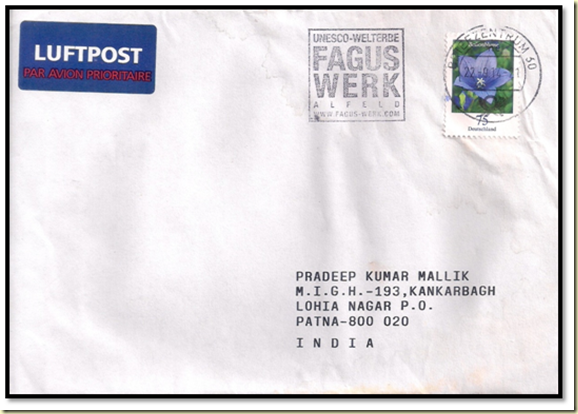
Before the release of this stamp, there were only two types of philatelic material related to Fagus Factory were available. There are shown nearby for reference.
image

Commercially used Cover with Special Postmark

image 

Commercially used Customized Envelope issued by the German Postal authority, Deutsche Post

- Pradeep Kumar Malik :  email : mallikphila@gmail.com


Club News

Stamp Exhibition on Art and Culture in Bangalore

A philately exhibition is proposed to be held from 09.10.2014 to 30.10.2014 at National Gallery of Modern Art, Bangalore on the theme "Ärt and Culture". The exhibitor are Mr Vernon Paul, Mr MR Prabakar and other KPS members. A talk on Philately by Sh.M.S.Ramu has been arranged on 12.10.2014 between 05.30 pm to 07.00 pm at NGMA, Bangalore during this exhibition period.

- Jagannath Mani - Bangalore

Thứ Hai, 18 tháng 8, 2014


image

Date of Issue : 21 August 2014

Hudson River School stamps

USPS will issue a set of four Forever stamps on 21st August 2014 featuring famous paintings of Hudson River School .

During the 19th century, the artists of a young America searched for a new way of viewing the world and found it in the very landscapes around them. Inspired by the stunning natural beauty of New York state, the loose-knit Hudson River School of painters flourished from the mid-1830s to the mid-1870s and gave America its first major school of art.

This 12th issuance in the American Treasures series features details of paintings by four renowned Hudson River School artists. The paintings on these stamps are: Distant View of Niagara Falls (1830) by Thomas Cole, from the collection of the Art Institute of Chicago;Summer Afternoon (1865) by Asher B. Durand, from the collection of the Metropolitan Museum of Art; Sunset (1856) by Frederic Edwin Church, from the collection of the Munson-Williams-Proctor Arts Institute; and Grand Canyon (1912) by Thomas Moran, from the collection of the Nelson-Atkins Museum of Art.

The Civil War: 1864 stamps from USPS

image

Date of Issue : 30 July 2014

USPS issued  two stamps on “The Civil War (1861-1865)”, the most wrenching chapter in American history, claimed the lives of more than 620,000 soldiers and brought vast changes to the country.

One stamp depicts the 22nd United States Colored Troops engaged in the June 15-18, 1864, assault on Petersburg, Virginia, at the beginning of the Petersburg Campaign. The other stamp depicts Admiral David G. Farragut’s fleet at the Battle of Mobile Bay (Alabama) on August 5, 1864.


Thứ Hai, 26 tháng 5, 2014


image image

Date of Issue : 22 May 2014

Here are new stamps on famous Theatres   . On May 22, 2013 the Ministry of Communications and Information of the Republic of Belarus  issued  stamp  on “National Academic Bolshoi Opera and Ballet Theatre of the Republic of Belarus” from the series “Theatres of Belarus”.

image

Date of Issue : 5 June 2014

On June 5, 2014 the Ministry of Communications and Information of the Republic of Belarus will issue a stamp “Grodno Oblast Drama Theatre.” Stamp was printed with the logo of the Grodno Regional Drama Theater. Grodno Oblast Drama Theatre opened in October 20, 1947 with the performance of “Truth is good, but happiness is better” by Alexander Ostrovsky .

nghe nhạc trực tuyếnNấu món chay | học nấu ăn DJ - Ảnh đẹp | xalotinnhanh